BYD, the Chinese clean-energy giant that dethroned Tesla globally and sent shockwaves through the European automotive sector, is confronting a severe brand reputation crisis in Pakistan, following the missteps committed by its local partner Mega Motor Company (MMC).
The ambitions of global EV powerhouse, which successfully tackled high European tariffs aimed at protecting legacy German automakers, is being bogged down not by governmental policies, but by mounting consumer dissatisfaction with due to mismanagement of its local partner, MMC.
Buyers of BYD vehicles in Pakistan are complaining of delivery delays, unexpected charges and slow after-sales service, raising questions about the readiness of local partner Mega Motor Company (MMC) as it scales up sales.
MMC has claimed that it has reached a milestone of 10,000 vehicles on Pakistani roads, marking the fastest ramp-up by a new-entrant New Energy Vehicle (NEV) brand in the country’s automotive history.
But several buyers told they booked against a 30-day delivery commitment and have waited months without clear updates. Buyers who tried to cancel said dealerships pointed to fine-print clauses in booking documents, and refused full refunds, imposing financial penalties of 5%.
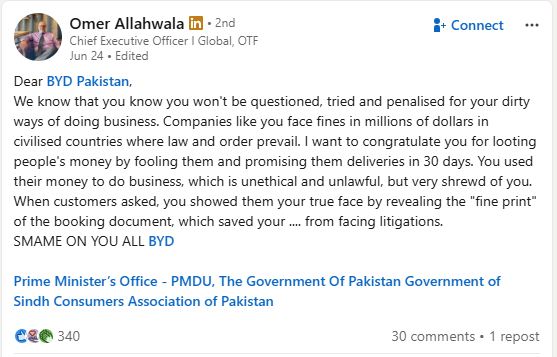
Omer Allahwala, CEO of Global OTF, publicly accused the local setup on LinkedIn of using customers’ money while relying on contractual fine print to avoid legal recourse over missed delivery guarantees.
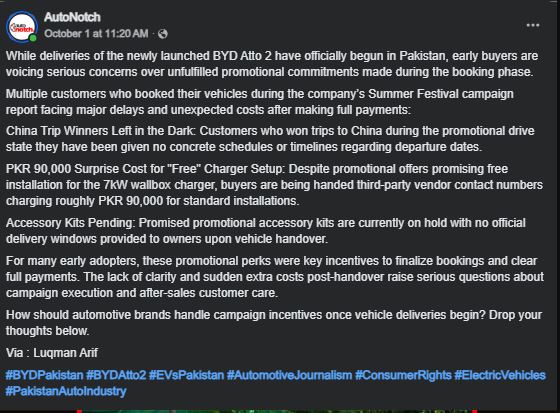
Similarly, an Autonotch, an auto-industry social media page with a large following among Pakistani car buyers, reported that “for installation of a 7kW wallbox charger buyers were given third-party vendor numbers charging roughly Rs. 90,000. It said promotional accessory kits are also on hold with no delivery date, and that these perks had been key incentives for buyers who cleared full payments before handover.”
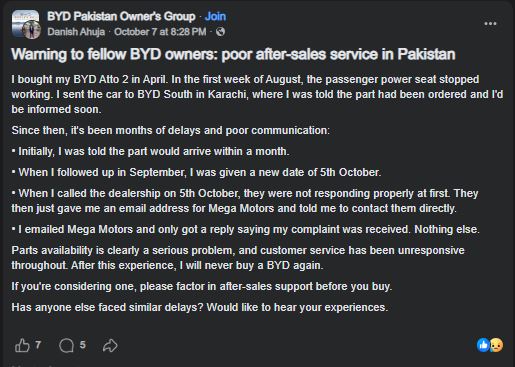
Danish Ahuja, a BYD Atto 3 owner, wrote in the “BYD Pakistan Owner’s Group” that he took delivery in April and that the passenger power seat failed in early August. BYD South Karachi told him the replacement would arrive within a month, he said, but follow-ups in September and October brought further delays. Staff eventually referred him to a corporate email address that sent only automated acknowledgments.
According to BYD Pakistan website, it operates from seven dedicated locations including two experience centers (Karachi and Islamabad), three authorized dealerships located in Karachi, Lahore, and Faisalabad while they have only two care centers (Karachi and Lahore). However, other EV Chinese brands, which are also getting overwhelming response, have more than 25 dealerships in across 15 to 18 cities.
Auto industry expert and parts manufacturer Mashood Ali Khan pointed to the government’s draft Auto Policy 2026-31, which is not yet in force. Under the previous policy (AIDEP 2021-26), he said, OEMs had 60 days to deliver vehicles; the draft cuts this to 30.
Under the draft, OEMs that miss the deadline would pay compensation at KIBOR plus 3%, advance payments at booking would be capped at 20%, and the booking price would be locked except for changes in statutory taxes.
Khan further urged the government to make 3S dealerships mandatory for OEMs, arguing that Chinese OEMs’ dealerships currently act mainly as sales agents with little focus on after-sales service.
Industry consultant Shafiq Ahmed Shaikh said the problems extend beyond MMC. He said that once a Chinese-brand vehicle is sold, replacement parts are rarely available off the shelf and often take months to import, and that available parts are priced beyond the reach of average buyers.
Because these vehicles depend heavily on software and electronics, he said, independent workshops often lack the expertise to repair them, and the few mechanics who do charge high labor fees. He added that official 3S (sales, service, spare parts) outlets are concentrated in upscale areas of major cities, making maintenance difficult for owners in smaller cities and distant suburbs.
By contrast, Shaikh said, Japanese brands keep their appeal through dealerships and workshops almost everywhere in the country, and parts available at affordable rates in local markets. He said sales milestones could quickly evaporate, if Chinese brands do not shift from selling cars to providing a dependable ownership experience. When contacted, BYD-MMC Pakistan had not responded to requests for comment.